
After meeting Nerlov in yesterday’s interview, it’s time to learn more about another artist participating in the SESAME Project.
The SESAME project aims to support the mobility of artists from regions surrounding the Black Sea, France, and the Republic of Moldova, fostering intercultural collaboration through music. Over the course of five creative camps held in Bucharest, ten bands come together for seven days to create, learn, and perform. Each camp concludes with a SESAME Live Session event, where the artists showcase their newly created music to a live audience.
We continue our journey in Republic of Moldova. Our guest is Mahaya, the second artist that you can see live at the first show in Control on November 19th.
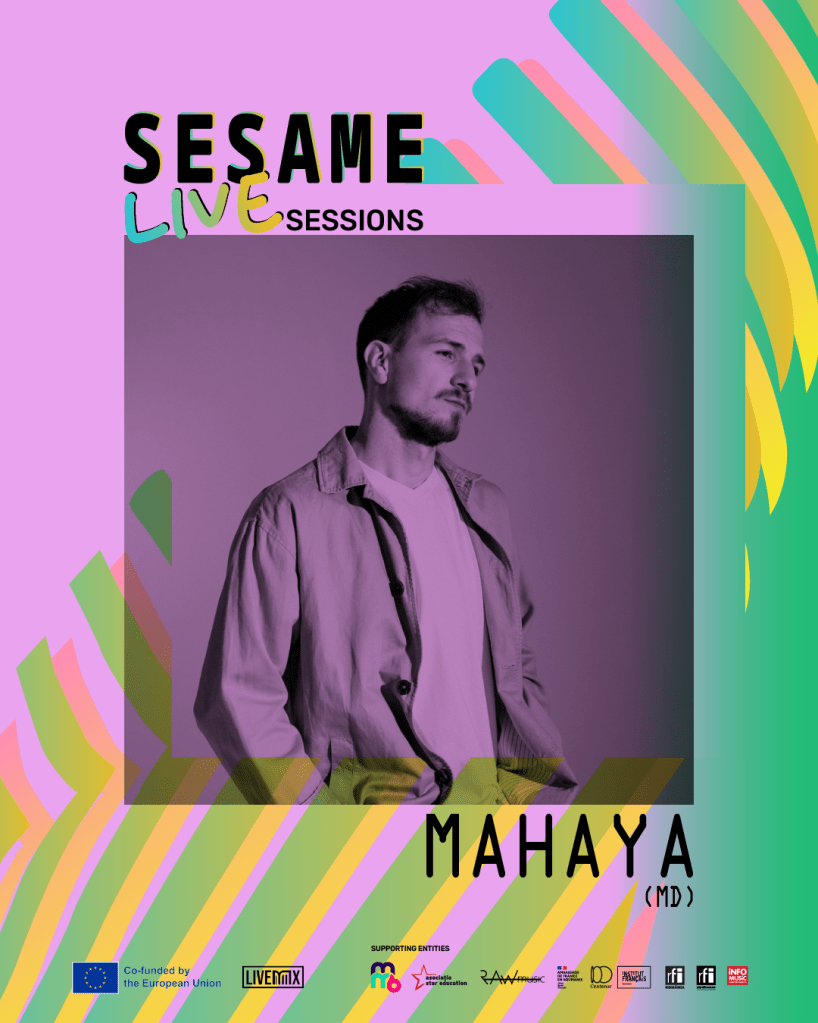
Who is Mahaya?
Mahaya is a talented artist and producer from the Republic of Moldova, born in the village of Taraclia, Causeni. After completing his studies in music pedagogy, Mahaya began his journey as a producer at 22, experimenting with various genres and collaborating with local artists.
He started sharing his musical creations in 2020, and by 2021, he was performing his original works live. Always evolving, Mahaya is constantly exploring new ways to define his sound.
In June 2024, he released Semnal în Vânt, an album of fresh tracks in an alternative format.
To help the public get to know you: what is one thing people should know about you before reading this interview?
I am MAHAYA, a versatile artist and producer from Moldova. I like to explore various genres to shape my own unique style. While most of my songs are in Romanian, I also have tracks in English. Most of my live performances have a alternative rock sound with elements of jazz, rnb and funk. In other words, I like to experiment with harmony, rhythms, and grooves.
If you could describe your musical style in one word and your local music scene in another, what would they be and why?
Although I explore multiple musical styles, the words that best describe my approach are “Freedom” or “Creativity”. For me, it’s important to express myself in the most authentic way. While it’s important to understand the rules, it’s equally important to recognize that those rules might not allow you the freedom to be ‘insane’ – in the best sense of the word. If you’re asking about the genre, I’d say “Alternative Pop”.
The local music scene is deeply rooted in folklore, which has been preserved in its authentic form up to the present day. However, living in a modern world, you can find a wide variety of musical styles here, from hip-hop and techno to indie, pop, and traditional folk. Many artists and producers experiment by blending folk elements with modern beats, and this experimental music has gained popularity with a broader audience.
If I were to describe my local scene in one word, it would be “Hybrid.” “Hybrid” reflects the fusion of diverse musical traditions, combining folklore with modern genres. It represents innovation, adaptability, and versatility, capturing both local and global influences in the evolving music scene.
What’s your favorite milestone in the process of creating a song—from the initial idea to writing, recording, and performing it live? What makes this moment special for you?
I can say that all steps are interesting in their own way. I am also a producer, and I create my own arrangements. However, my favorite moment in the process is listening to the track after days of working on it and saying, “Yes! This is the final version!”
What impact has the support of friends, family, or fans, as well as your participation in camps, conferences, and workshops, had on your career so far?
It’s really important to have the support of my family, wife, and friends, but what really motivates me are the messages from random people telling me things like, “I just discovered you”, “you’ll go far”, or “I have you on repeat”
How did you hear about the SESAME Project, what motivated you to apply, and how do you see it impacting your career and presence in the European music scene?
I heard about the Sesame project from my lawyer, Florin Mihailov.
I decided to apply because it’s outside my comfort zone. Communicating in English and interacting with artists from other countries will be new and exciting for me. I believe this experience will enrich my career and could open doors for me in Europe.
What challenges do you expect to face in this program, and is there anything you’re nervous about? What skills, knowledge, or qualities do you hope to gain or bring to the creative camps, and what’s your biggest goal for this project?
One challenge I anticipate is adapting to new ways of working and collaborating with artists from different backgrounds. Performing for a completely new audience is also something I’m looking forward to experiencing.
My main goal is to gain new experiences and push myself by performing for a different audience, feeling their feedback, and seeing how my music resonates. I also hope this experience might open new opportunities for me across Europe.
What do you hope the Bucharest audience will feel during your performance? Is there a memorable concert moment from the past that you’d love to experience again?
I hope the Bucharest audience will truly feel the entire vibe of the songs—not just through the lyrics, but through the energy, rhythm, and atmosphere we create. It’s more about connecting to the groove and letting the music move them, feeling the intensity beyond words. That’s the kind of connection I’d love to bring to Bucharest.
If you could give one piece of advice to underground artists who are reading this interview, what would it be?
My advice to upcoming artists would be simple: ‘If you do nothing, nothing happens. If you do something, something happens.’ It’s all about taking action, even if you don’t know exactly where it will lead. Every step forward—no matter how small—can open new doors and opportunities. BEST FROM MAHAYA
Interview by Ana-Maria Corjos and Radu Mihai
 Rock Monsters Romania
Leave a comment