
After its successful 2024 edition, Overground Music and the National Theatre Bucharest announce the return of Rooftop Season, the coolest open-air musical experience of the summer.
Following the big success of byron’s sold-out show on July 7th, the series continues with another sold-out show, this time featuring Luiza Zan and Jazzpar Trio.
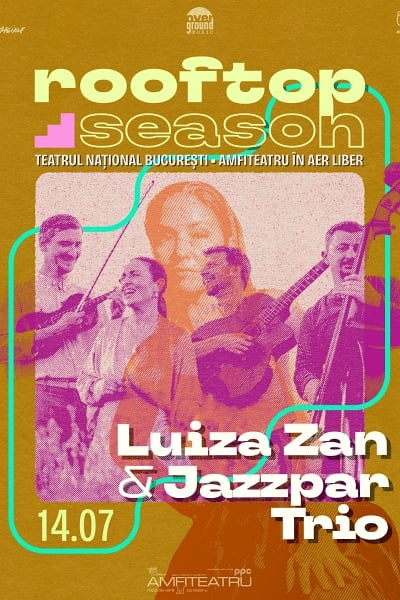
Luiza Zan, together with Jazzpar Trio, brings to the stage the unmistakable charm and vibrant sound of 1930s Paris, the world of the legendary Django Reinhardt. A member of the Manouche clan, Reinhardt was inspired by American jazz, to which he added his own original flair, ultimately giving birth to a complex and passionate new genre: gypsy jazz, also known as manouche jazz.
The Jazzpar project is the realization of a shared dream that the trio’s founding members had nurtured for many years. Each musician brings a rich background of diverse musical experiences, exploring everything from rock and flamenco to jazz, funk, and even electronic music. In 2017, after years of anticipation and preparation, their vision of creating a gypsy jazz band finally came to life. Today, Jazzpar Trio’s repertoire includes well-known pieces such as Minor Swing, Django’s Tiger, Softly, Bossa Dorado, La Vie en Rose, and many more, all reimagined in a style that combines the classic gypsy jazz sound with their own distinctive touch.
Luiza Zan’s incredible international career is marked by numerous prestigious awards and recognitions. She won the Jury Prize at the Montreux Jazz Voice Competition in 2003 and took second prize at the same competition in 2004. That same year, she earned first prize at the “Golden Stag” Festival with the group Slang. In 2011, she was named “Musician of the Year” at the Muzza Jazz Awards Gala.
We talked to Luiza Zan ahead of her concert at the National Theatre Bucharest about her career and why we need jazz in our lives, in an exclusive interview.
Luiza, you are a well-known artist, but if you had to introduce yourself to a new fan using just one word, what word would you choose and why?
Free. It’s my word of choice, because being free in my mind and in my spirit motivated my choices so far and made me the person and the musician that I am.
You have the only jazz show in the Rooftop Series, so I have to ask: why do you believe everyone needs a little bit of jazz in their life, and how important is jazz in shaping their musical culture?
I don’t think that everyone needs a little bit of jazz in their life. Jazz represents freedom within a complicated structure. Both can push back people and I totally understand why most people would prefer genres that are easier to listen to. But to me jazz is the most expressive music of the deeper emotions and I couldn’t live without it, so I basically sing for my own personal endeavour. Hopefully it inspires people to search for the music that best portrays their deep emotions too.
What role do you think jazz plays in Romania today, and how do you see it evolving in the future?
I think jazz is very hip nowadays, we have very cool festivals and young musicians to fill the stages, also, the jazz fans are loud and sassy, so I see a very cool future for jazz. This hot summer, I feel that jazz could be the coolest vibe!
Jazz is always associated with emotion. What expectations do you have from the audience? How does a concert feel from the perspective of a performer compared to that of a simple audience member?
Oh, I simply expect the audience to give in to their emotions, to cry if they feel like it, to smile if they need to, to be open and honest. That’s how we are, too. We sometimes cry, too. I always say to my fellow musicians, whenever I don’t sing, I have the best seat in the audience, because I get to admire and listen to them, so I will always try to blur the fine line between the stage and the audience, so that at times people can feel hugged and caressed by the music as if they were on stage with us.
You’ve also evolved through different genres, combining them and singing in multiple languages. What has been the most challenging transition or turning point for you? And which one was the most important for your career?
I think the most challenging musical project was the recent recital I had in Targu Mures at the Palace of Culture. I sang Sergei Rachmaninoff’s Romances, a very difficult classical singing repertoire. But the real challenge was respecting the original scores, singing without transposing the music, so I set myself on a difficult journey of shaping my voice very differently. I couldn’t have done it without the help of the amazing pianist Santha Huba, who believed in me and in this crazy personal challenge. I don’t know if it mattered for my “career” per se, but it sure changed my own perspective on singing and I feel so much stronger now, knowing I could do this.
Besides all this, you’re also deeply involved in community projects. How do you balance everything, and does this involvement inspire your music in any way?
Being a part of a small village community, deeply inspired the outcome of my latest album and also inspires me to continue to compose. Living in a strong bond with nature means so much more than people realise. You want to go back to reading, to writing, to observing, to feeling. In the city, we get caught up in the tangles of virtual reality and lose track of our emotions. But out here, you face them from the second the sun kisses you awake until the moon lulls you to sleep. So I have to be thankful every second for this community, because I feel free to feel, to see, to sing. I try to give back as much as possible.
Beyond your stage career, you also have a career off stage as a jazz teacher. What has been the most important lesson you’ve learned while teaching, and how has it helped you grow as an artist?
I think I learn from my students every day. I take something new with me after every class and every new student. At the end of July, I am expecting new students for my Master’s in Musical Theatre in Targu Mures and I am super excited to meet my new cast.
Working with my students taught me the art of listening. That is a very important craft and I am thankful for the opportunity to study that as a singing teacher.
In a past interview, you mentioned that you grew up as a rocker. From the Rooftop Series lineup or not, which bands would you like to share the stage with to create a jazz-rock fusion? And why?
I already know what sharing the stage with byron feels like and I’d love to feel those feelings again. Singing with them gave me an insight to the rock audience, much louder and fonder of their beloved artists than the jazz audience. But I would never say no to an interesting musical invitation and all the artists who are lined up in this Rooftop Season are interesting and diverse. Jazz can add an interesting colour to absolutely any fusion.
What message do you have for the people who are reading this interview and coming to your show?
People want experiences, not shows, so we want them to experience many beautiful things that they can take away. The magic of reading, the beauty of remembering childhood, the deep green of the forest caught in a musical piece… Please come with open hearts: we will pour some magic.
The show at TNB is currently SOLD OUT. Tickets for the next Rooftop Season concerts can be found here.
Interview by Radu Mihai
 Rock Monsters Romania
Leave a comment