
Dl Goe have always allowed their music to grow alongside them. From the theatrical, character-driven world of Tineri, Sâmbătă, Duminică to the larger universe of Fata Morgana, their songs have rarely existed without a story, a character or an entire world built around them. 23 feels different, but not unfamiliar. Rather than leaving those earlier worlds behind, the band seems to be opening itself towards something looser, more spontaneous and more instinctive. There is a particular energy to watching them like this, away from the stages and narratives that have shaped so much of their identity. For once, there is nothing they need to become for the audience. They simply exist within the music, and somehow that makes Dl Goe feel more alive than ever, not like a different band, but like one that has just remembered how much more it can be.
Recorded on August 23, 2025, at 23 August Beach and released exactly one year later, 23 is an eight-track live album captured during a single sunset. The accompanying live session makes the setting inseparable from the record: no audience, no stage, no elaborate production competing with the landscape. Just sand, wind, instruments and the Black Sea slowly disappearing into darkness.
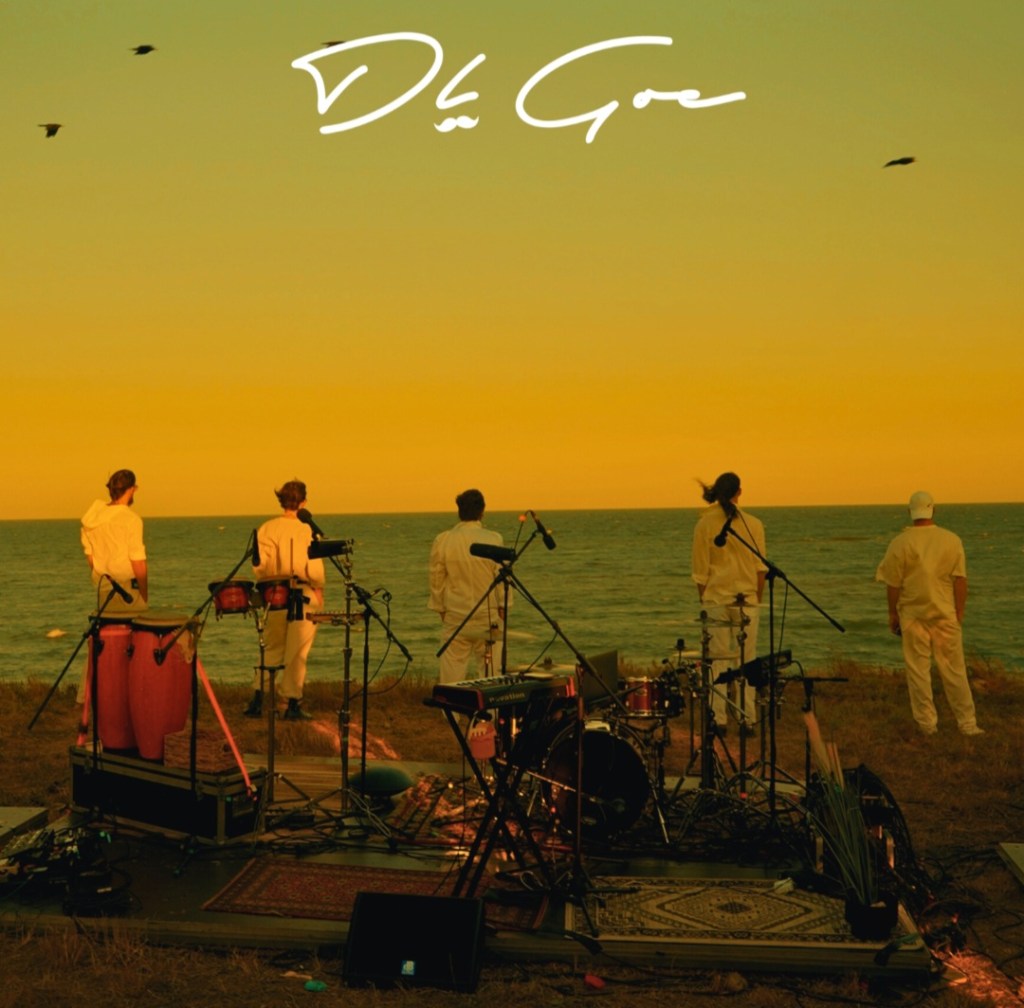
I have watched bands from a lot of strange angles over the years, usually looking for the frame where a concert becomes something more than a performance. None of that quite prepared me for watching Dl Goe like this. Without a crowd or barricade to separate the musicians from the camera, the smallest things suddenly become visible: a glance before a song, someone adjusting an instrument, the pause before the next track. The absence of an audience does not make the session feel emptier. It makes it feel exposed.
And that exposure works because Dl Goe have never really sounded like a band built around one central voice. Dani Ionescu’s vocals and keys sit alongside Andrei Doboș’s bass, Cosmin Stanciu’s guitar, TZ’s drums and Horea Suciu’s saxophone, percussion and vocals. What holds the band together is less an individual performance than the way all these different instincts meet.
On 23, that chemistry becomes particularly easy to watch. The transitions between songs are left visible, rather than hidden behind cuts or production. Horea’s saxophone and percussion add colour without overcrowding the arrangements, TZ carries the momentum between songs, Dani moves naturally between vocals and keys, while Colorian adds another layer to the increasingly spacious sound. Cosmo’s guitar, meanwhile, seems deliberately uninterested in taking over the frame. He knows when to let a phrase linger and when leaving space says more than another solo could. There is a quiet confidence in that restraint. That becomes important once the album begins.
Angel Radios is an interesting choice for the opening because, from the very first lines, there is something familiar about it. The lyrics are recognisable from La coadă la Mega Image, a song that already existed in Dl Goe’s repertoire, so there is an immediate sense of recognition for anyone who has heard it before. What changes here is not necessarily the story itself, but the way it is presented. Familiar lines are taken out of their original context and given a new life within the 23 session, surrounded by the sea, the open space of the beach and the changing light. Rather than feeling like a completely new song, Angel Radios works almost like a memory being revisited. You recognise where it came from, but the setting makes you hear it differently. The live arrangement gives the lyrics more room, while the guitar sits naturally alongside the vocals instead of trying to recreate the energy of the original. It is a subtle way of opening the album, with something the band has already said before, but from a place that allows them to say it differently.
That is perhaps the first clue to what 23 is actually doing. The album is not trying to turn these songs into something entirely new. Instead, it gives familiar pieces a different context, allowing them to breathe differently and reveal parts of themselves that may have been less visible before.
Then comes Primaru’, and the album immediately reminds us of one of Dl Goe’s most distinctive qualities: their ability to embrace the absurd without ever losing their musical identity. The premise is simple, becoming the mayor of Constanța. Yet the geography of the joke suddenly becomes part of the performance. The band is literally standing by the Black Sea, singing about becoming its mayor. At one point, Dani, Cosmo and Horea sing together, „El e primarul din Constanța”, and the song suddenly becomes even more playful. There is something wonderfully spontaneous about the moment, the three of them sharing the line, completely leaning into the humour of it, without trying to make it more serious than it is. It feels natural precisely because they allow themselves to have fun with the song.
That balance between sincerity and humour has always been part of Dl Goe’s identity. What feels different on 23 is the freedom with which they allow those moments to exist on their own. They do not need to be part of a larger fictional narrative to work, the humour comes directly from the musicians, their chemistry and the shared understanding behind the song.
If Primaru’ reminds us where Dl Goe came from, Seniorita points much more clearly towards where they are going. Released on March 1, 2026, with its launch concert at Control Club, Seniorita already had a life before reaching this album. I first encountered the band there, so hearing the song again months later, now performed exactly where its imagery seems to belong, feels strangely circular. The song is almost shamelessly summery. „Te-am văzut pe plajă, valuri și nisip” immediately establishes its world, followed by waves, sand, and attraction. But underneath all that carefree energy is a small sense of urgency: „Încă suntem tineri și asta ne doare”. Summer, youth and desire are all temporary, and the song seems to know it.
Cosmo takes over part of the vocals with „Ochi în ochi / Și buze în buze / Mă privești lasciv / Am rămas fără scuze / Dacă vrei / Dansăm în trei”. His entrance shifts the song into something more mischievous, almost conversational. There is something particularly fitting about hearing him deliver this part, especially given the way he has a habit of approaching things with a certain openness to curiosity and experience, the kind of try everything twice philosophy that seems to follow him beyond the stage. Here, it almost feels like an extension of the song itself, playful, spontaneous and not too concerned with taking itself too seriously. It is one of those moments where the band’s chemistry becomes more interesting than any individual performance.
And then, naturally, the song ends up at „În curând voi fi / Primarul din Constanța”. After Primaru’, the line becomes an inside joke between tracks, making 23 feel less like eight isolated performances and more like a small universe in which the songs talk to each other. Musically, Seniorita also makes the band’s new direction hard to ignore. There is more groove, more rhythmic freedom, something warmer and more physical. The theatricality is still present, but it has become lighter. Dl Goe no longer needs an entire character-driven universe to create a scene. Sometimes a groove, a beach and a ridiculous line are enough.
The mood changes with Te iubesc, dar nu pe tine, one of the album’s more interesting contradictions. It is groovy, almost easygoing, while the lyrics deal with the uncomfortable distance between loving someone and no longer recognising them. „Nu te recunosc nici după parfum” is such a simple line, but it captures something much larger: intimacy can disappear without the memory of it disappearing with it. There was chemistry, „ca o simfonie”, but the symphony has been left without volume.
The song’s most unsettling thought comes later, with the possibility of waking up one day without any memory at all. What happens when even the photographs stop meaning what they once meant? It is a breakup song that refuses to behave like one. The music keeps moving while the lyrics are quietly dealing with emotional amnesia. That contrast is very much in keeping with what 23 does best, allowing sadness and movement to exist at the same time.
By the fifth track, O noapte furtunoasă brings another piece of Dl Goe’s past into the present. Originally released on Fata Morgana, the song arrives here in a setting that changes the way it is heard. Removed from the context in which we first encountered it, it feels more open and immediate, as though the song has been given the chance to exist on its own terms. The arrangement feels looser, warmer and more nocturnal, with a low, almost surf-rock quality to the guitar and a bluesier groove underneath. The song still carries its original romantic dreaminess, following someone by her perfume, dancing under the stars, getting lost somewhere between reality and fantasy, but it no longer needs a fictional universe around it. Technically, this is also where the live session becomes especially compelling. The camera does not constantly chase the biggest moment. It lets the musicians and the landscape coexist in the frame, while the changing natural light becomes its own visual timeline. By this point, the evening is visibly moving towards night.
Then Mereu aproape slows everything down. Dani moves towards the keyboard and the song begins almost without ceremony. There is no need for a dramatic transition. The band simply settles into it. The lyrics are about a connection that exists somewhere outside explanation: „Nu pot să explic cine suntem / Sau de ce ne-am întâlnit.” It is about having a place with someone that belongs to neither time nor routine, a private space that somehow continues to exist even when the two people are apart. „Te simt mereu aproape” is not necessarily about physical closeness. It is about the kind of presence that survives distance.
Most of us probably have someone like that, someone we could stop speaking to tomorrow and still somehow feel beside us months later. Maybe that is why the song works so well. It describes something deeply personal without trying to make it overly dramatic. The three-part harmony between Dani, Horea and Cosmo makes the idea even more effective. Three voices occupying the same space for a song about emotional proximity is almost too fitting.
By O iubire de-o zi, the evening is beginning to settle into its final stretch. The light is softer now, and the session is slowly moving towards its closing moments. The lyrics „Și dacă mâine n-oi fi, / Un singur lucru aș vrea să știi / O iubire de-o zi / E tot ce-ți pot oferi”, make no promise of permanence. And somehow, that makes the song feel more sincere. Not everything has to last to matter. After Mereu aproape, which imagines a connection surviving distance, O iubire de-o zi asks the opposite question: what if something is meaningful precisely because it is temporary? The progression of the album begins to mirror the landscape. It started with the warmth and openness of a late summer afternoon and gradually moved towards something darker and more reflective. The changing colours are not simply beautiful visuals, they become part of the emotional structure of the session. By now, 23 feels less like eight songs and more like watching someone move through an entire emotional cycle: attraction, excitement, desire, nostalgia, uncertainty, intimacy, acceptance.
And then comes Despre tine. At almost nine minutes, Despre tine is the longest track on the album and its final statement. It begins with a low, restrained guitar line that carries something vaguely Western in its phrasing, cinematic, dusty, almost like the beginning of a road movie, but without becoming grand. It feels deliberately small. The lyrics move between memory, fantasy and time: „Te visez de când noi ne-am văzut”. Towards the end, Horea introduces a handpan, and suddenly the song seems to leave the ground. The instrument’s resonance hangs around the guitar and vocals, while the final images of the session become increasingly dreamlike. It is probably my favourite song on the album.
Not because it is necessarily the most technically ambitious, but because it feels like the place where everything Dl Goe have been and everything they seem to be becoming briefly meet. The storytelling is still there, but it is quieter. The newer interest in groove and texture is present, but restrained. The theatrical instinct has not disappeared, it has simply moved inside the music instead of sitting around it. There is something almost like resurrection in that. Despre tine feels as though Dl Goe have brought an older part of themselves back to life without trying to recreate it exactly. They remember what made the band feel like the band, but they are no longer afraid to let it change.
And the final line, „Noi mereu vom fi doar doi copii sub soare”, does not resolve anything. It leaves the song suspended somewhere between nostalgia and hope. That is also the most accurate way to describe 23.
This is a huge departure from the Dl Goe we have been taught to recognise. A band associated with characters, theatrical worlds, elaborate narratives and a very particular kind of spectacle has suddenly taken almost everything away. No stage. No crowd. No fictional universe. Just eight songs, five musicians, a beach and one evening disappearing in real time.
At times, that stripped-back approach exposes how much of the old Dl Goe identity depended on the worlds they built around their music. But that is exactly why this live album is so interesting. 23 is not trying to prove that they can sound different. It is asking how much of Dl Goe can remain once the familiar architecture is removed.
The answer, surprisingly, is quite a lot. The blues, rock, jazz and theatrical instincts are still there. So are the absurdity, romance and storytelling. But now there is more groove, more space, more willingness to let a song exist without explaining itself. Seniorita, Funku and 23 suggest a band becoming increasingly comfortable with rhythm, texture and genre fluidity.
And perhaps that is where 23 becomes most exciting. The band is not simply changing the way they sound, they are changing the way they allow their music to exist. The songs no longer need to arrive with a complete explanation, a character to follow or a world to step into. They can be playful, romantic, strange, groovy or vulnerable simply because that is where the music takes them. And somehow, in taking away so much of what we thought made Dl Goe Dl Goe, they have made the band feel more alive than ever.
That is what makes 23 feel less like a definitive statement and more like a moment of transition. It feels like a band opening a door without telling us what is on the other side. They are figuring it out as they go, and, for once, we get to watch that process rather than only seeing the finished result. After eight songs about desire, memory, fleeting love, closeness, dreams and everything we leave unsaid, the album ends with the feeling that the band is standing at the same kind of threshold as the people inside these songs: looking back at what was, feeling what is, and quietly wondering what comes next. The really exciting part is that, if this is what Dl Goe sounds like while they are still finding their way into this new space, it is difficult to imagine where they might arrive once they fully settle into it. And if this is only the beginning of that freedom, then perhaps the most interesting Dl Goe album is still the one we have not heard yet.
Review by Bianca Strechioiu


Leave a Reply