
After years of operating as a DIY community dedicated to Romania’s alternative music scene, Stray Lights became a festival. Between July 31 and August 2, Stray Lights Festival and Control Club launched the inaugural edition of an event built around music that refused to be confined by genre boundaries, as well as around an idea that had been at the heart of the project from the very beginning: music needed spaces where it could be discovered, and people needed places where they could come together around it.
One of the bands on the line-up was Black Water. Originating from Brașov, Black Water explores the space between dreampop and post-wave, creating melancholic and atmospheric soundscapes inspired by bands such as Cocteau Twins, The Cure, and Drab Majesty. Their debut EP, Safe From Reality, released in 2024, already established the identity of a band that transforms reverie and introspection into captivating sonic experiences.
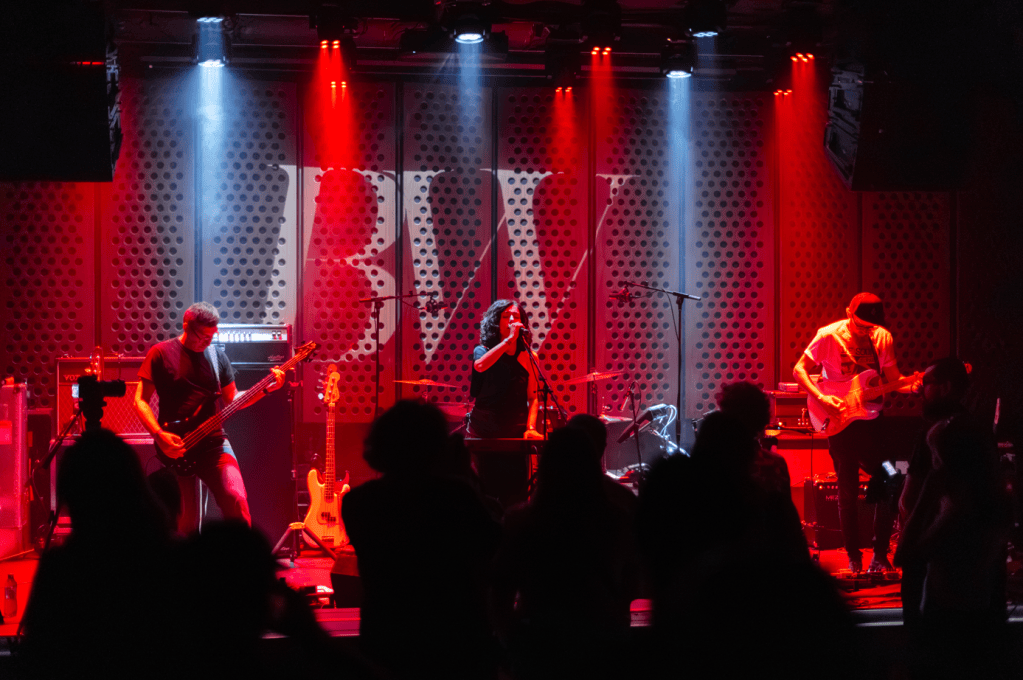
We talked to them after their performance from the festival and here is what we found out.
The first question is a bit of a cliché one, but if you had to describe your music in one word, which one would it be and why?
Anca: Dreamy – because every time I write a song, it feels like a dream transposed into music.
Marius: Dreamy and also melancholic. For me, it’s a form of reflection, a way of drowning into a space of intense emotions.
People are wondering how you came up with such a cool and mysterious name. Can you tell us the story behind it, as well as the story behind the band itself?
M: The band was founded by Silviu Pop and me in 2017, and that’s also when we came up with the name. There’s actually nothing particularly spectacular behind the choice. We simply liked the way “Black Water” sounded, and we felt it captured our musical direction really well. Before Anca joined the band in 2022, our sound had some darker elements, but that melancholic touch was already there. We released two records with the previous lineup, each featuring a different lead vocalist: Heartbeats in 2017 and Oceans of Scars in 2021.
What song that you have already released do you think represents the band the most, and why?
A: Geiko – it was partially composed at home and partially at the rehearsal studio during a sort of jam session. Let’s just say that the planets aligned perfectly for us when we wrote it.
M: Lately, I’ve really started to love Maze, especially when we play it live. I think it’s a very well-balanced and well-structured song, with the synths, guitars, and vocals all complementing each other really nicely.
Your last release was back in February 2025 with In Another Life. Are there any songs currently in the works that are expected to be released before the end of the year? Or maybe even a new EP?
M: Actually, after In Another Life, we released a live session version of The Wheel, which is available on YouTube. At the moment, I think we’re working on around six songs. We generally like to work on several tracks in parallel, rather than focusing on just one at a time. We’re planning to release a new record in the spring of next year, and maybe a single at the end of 2026.
A: We are currently working on some new songs. We hope to have something finished by the end of the year, but we also don’t like to rush things since everything is funded by our own budget. We like to record songs that we feel are special and have a clear message.
You have shared the stage at the Stray Lights Festival with some great names. Which band were you most excited to see live? And if you had the opportunity to make a song featuring one of them, which band would it be and why?
A: I was impressed by Orkid. I liked them more live than on their recordings; they felt more “alive” and atmospheric.
M: Unfortunately, I could only stay for the first night, when we played as well. I was really happy to see Orkid. I’d been listening to their releases for a while, but somehow I’d never managed to catch them live. I think they deliver much better on stage, and the experience is much more intense than simply listening to their albums. But for me, the real revelation of the night was The Murder Capital. To my shame, I hadn’t heard of them before, but they had a huge impact on me. It was one of the most intense live experiences I’ve had in a long time.
What did you feel you brought to the Stray Lights Festival that was different from any other concert?
A: A new kind of music inspired by our childhood idols.
M: Maybe we shouldn’t have opened the festival, but a little bit of melancholy is always welcome.
How important is it for new bands, especially those that are not from Bucharest, to have DIY festivals and concerts in Romania? What should improve in this area?
M: It’s incredibly important to be part of a community where we all try to support one another as much as we can. We genuinely love the bands at Stray Lights. Some of them are already our friends, and we’re looking forward to meeting the others at the festival. In general, it’s quite difficult to express yourself on stage in smaller cities, simply because there aren’t many opportunities or venues. I think the communities that come together around concerts in DIY venues are extremely important for the growth of the alternative music scene. From that point of view, we’ve been very lucky to have Club Control, it’s definitely the place you want to be.
A: It is important to have smaller festivals like this so we can bring our music to more people. It’s hard to play at a big festival because you can easily get lost in the multitude of new bands. Personally, whenever I go to a bigger festival, I’m more interested in the small bands playing on the small stages. Sometimes I discover an unknown band and become a fan.
What do you hope that the people who saw you live at the Stray Lights Festival experienced?
A: A new vibe created by “not-so-famous” bands that have a non-commercial approach to music.
M: An experience of inner reflection, perhaps with a touch of nostalgia, something that makes you feel fulfilled and leaves you wanting to experience it all over again.
Interview by Radu Mihai


Leave a Reply