
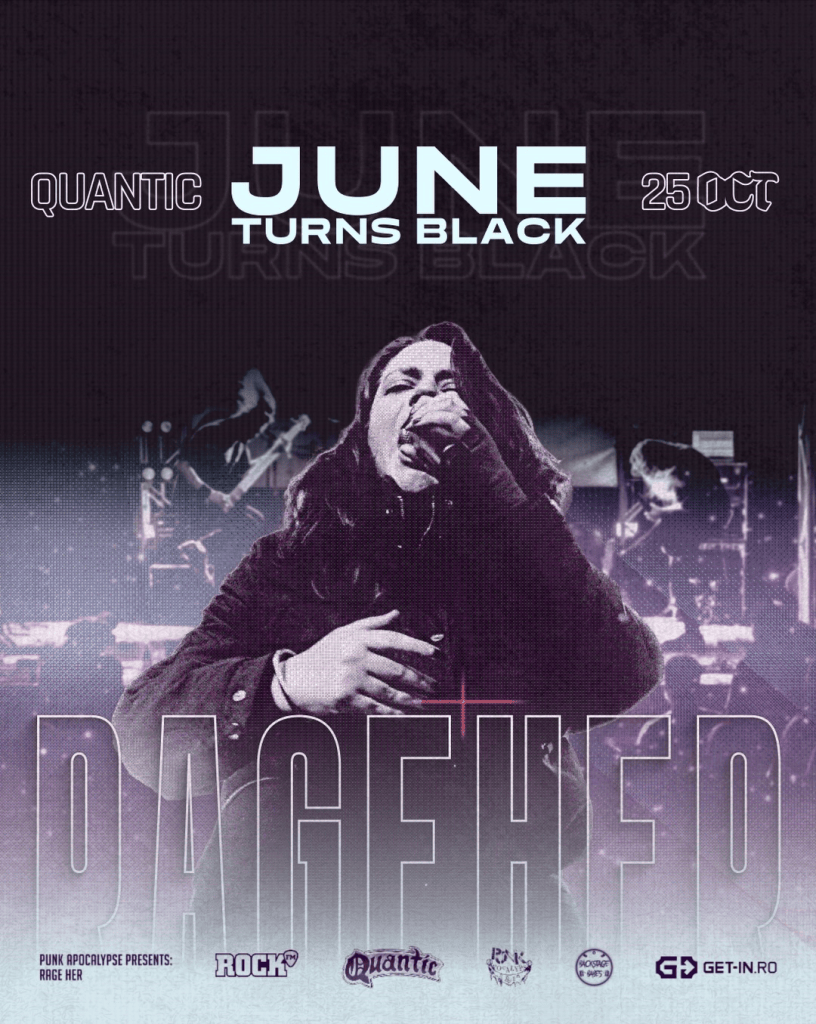
They say metal is a male dominated genre, but on October 25 at Quantic Club, women are here to change the rules. RageHer is a project conceived and organized entirely by women, born from a simple desire to shine a spotlight on the women making waves in Romania’s rock and metal scene. No clichés, no half measures, just heavy music, pure energy, and a lineup showcasing the diversity and power of female artists performing aggressive styles in the underground scene.
One of the bands from the line-up is June Turns Black. Emerging in Bucharest in 2023, June Turns Black prove that a band can sound fresh while being fiercely aggressive. With clear influences from bands such as Architects and Bring Me the Horizon, they strike the perfect balance between crushing breakdowns and deep melodic lines. Their lyrics explore inner struggles and personal transformation, delivered with unfiltered intensity and brutal honesty, while their stage presence is guaranteed to electrify the audience.
Before the show, we spoke with Rach Alaji, the band’s vocalist and a well-known extreme vocal coach in the Romanian metal scene, about her career, her musical influences, and her expectations for the future.
What are the things people should know about you before reading this interview?
Hi! I’m Rach Alaji, happy to be here! I’m the singer and creative director for June Turns Black, an electronic noir screamo rock band from Bucharest. I’ve been in the scene for many years and have been wearing a lot of hats this whole time. I used to play bass, and now I practice one of the hardest vocal style fusions possible: pitched screaming (think Sam Carter) and pop singing (think Dua Lipa).
I handle the direction and production of our music videos, which involves everything from costumes, make-up, props, set construction & design to editing and color grading.
I’ve also become a vocal coach, since I’ve noticed a severe lack of proper respect and information regarding the technique of extreme vocals in our country, so I work with young singscreamers on their journey to become the next big voices in our scene.
A little known fact about me is that I’m also a trained theater actor.
Which woman inspired you from the beginning? What have you learned from her as a model?
My mom and Tina Turner have been role models for me throughout my life. Why? Because they’re badasses and they don’t put up with sh*t.
My mom, since she was a flight attendant (the head of the cabin crew), she taught me discipline, aesthetics, and independence. She had a very chaotic and difficult schedule which, looking back, is very similar to my schedule as a full-time employee and artist with all the touring, late nights, and work that needs to be done in order to build up a band. She also taught me how to install tiles in a house, haha!
Tina Turner showed me that it’s important to have courage and self-confidence in life and especially in the music industry. When I think of her, a word comes to mind, which can’t be translated into English: “tupeistă”.
Why have you chosen the music industry? Where does your passion come from?
I did not choose the music industry. The music industry chose me. Or rather, the entertainment industry, since I didn’t start with music, but with acting. There is no “why.” It just simply is.
The passion comes intrinsically, because there is an ineffable drive that cannot be stopped. Think of the Call of Cthulhu, but Cthulhu is the stage.
Was there a moment when another woman warned you about the challenges you might face in the music industry because you’re a woman? What was your reaction?
Nobody told me sh*t. I had to face all the challenges of being a woman in the male dominated heavy music scene head-on.
Have you faced any challenges that could only happen to women in this industry? Can you give us some examples and explain how you overcame them?
For example there rarely are safe spaces where a woman can change before a show and not share those spaces with the venue staff or 5 other sweaty dudes. The only way I overcame this, for example, was either changing at the hotel, coming in and already wearing my stage clothes or changing in the van, which, let me tell you, really isn’t a nice experience. I’ve even had shows where I gave up on changing into my dedicated stage clothes (and adding to the quality of the show) because it wasn’t really an option.
Another example I never see people talk about is performing with menstrual pain: in lots of cases the voice changes too and in the particular case of extreme singing there is a lot more pressure involved on the body and the larynx to hit your pitches. You also have to deal with nausea and seem like everything is fine, sometimes in over 40 degrees of heat with no fans on stage.
For my personal experience, all the above gets combined with tremendous amounts of pain from my polyarthritis (an auto-immune disease which targets all the joints and ligaments in the body, including my vocal chords).
And even with all that, I get up on stage every night and give it my all and I don’t complain, this being the first time I’ve shared these thoughts publicly. I love what I do and wouldn’t change it for anything in the world.
Have you ever felt pressured to present yourself in a certain way because of your gender?
Of course. I was even told (indirectly, through things said to my bandmates) that I should show off my body more, to give “something nice for people to see.”
I understand that it is a thing that happens in the entertainment industry, but in heavy music the emphasis is on self-expression, community and artistry. However, oftentimes talent and hard work are overlooked in favor of displaying one’s body. And even if I do choose to show skin, it’s going to be on my terms and not because anyone told me to.
What changes would you like to see in the industry to make it more inclusive and welcoming for women?
First of all: safe changing rooms. I cannot stress how important this is, and I’m not talking about a cramped closet, a tiny bathroom, or a hallway for staff and storage. These should not be optional, but mandatory so that we can perform on stage. It’s not just about the clothes, but warming up and getting into the headspace in order to deliver the best show possible for the fans.
Second, I’d like to see a mentality shift in the way female artists or bands that include women get categorized and treated like we’re in a special category like the “Women’s NBA.” The term “female-fronted” gets thrown around a lot, and we need to realize this doesn’t describe the sound of the artist, it describes the gender of the artist.
This means that the artistry is second-hand. We often get compared to other bands that have a female singer because of that label, even though we consider ourselves closer to a variety of artists. Even my extreme vocal technique is inspired by Sam Carter from Architects and Oli Sykes from Bring Me The Horizon, both of whom are men. Music is music, it’s for everyone and by everyone and women shouldn’t sit at the kid’s table.
How optimistic are you about the future of the music industry in terms of gender equality?
I’d prefer this interview to be honest, so I’ll say I’m cautiously optimistic. I have seen some positive changes with a lot of bands and artists that include women getting more popular, seeing more women and girls at concerts in the audience and more women in key positions in the industry.
We need more female voices to be heard, and RageHer is a great example of that: an event made by women, with women, for everyone. I’d also like to add here that I think the music industry and the scene should be made safer and more inclusive for LGBTQIA+ people as well. Diversity is good and should be encouraged.
Can you share a memorable experience or achievement in your career that you’re particularly proud of?
Yes. I never thought screaming would get me a “best singer” award, but here we are! (thank you Constelatii Rock!) I was shocked back then, I’m still shocked now.
I’m also incredibly proud to have played at Rockstadt Extreme Fest, and on the same stage as Pendulum, who I’ve been listening to since I was 8 years-old and are a big influence on our music as well!
Are there any projects or collaborations you’re currently working on that you’re excited about and would like to share with our audience?
I’m incredibly excited to let people know about my band’s new album, which is in the late stages of production: “thedarkplace.” It’s a 14 song behemoth going through a myriad of musical styles and showcasing a ton of different vocal techniques. It’s easily the biggest project I’ve worked on so far, at least in a musical sense.
On the visual front, I’m working on the post-production for our next music video, for our song “gods-dont-limp” for which I handcrafted four sets and four costumes, so that’s pretty crazy as well and I can’t wait for people to see it!
Looking back on your career journey so far, what are some valuable lessons or insights you’ve gained that you wish you knew when you were starting out?
I would’ve started earlier with my extreme singing. I loved playing bass, but with singing I really feel like I’ve found my true and complete form of expression. Moreover, the level of difficulty with my technique requires a lot of years of hard work and dedication and getting an earlier start would’ve been helpful.
You are going to perform at RageHer, a special event by Backstage Babes that celebrates three amazing Romanian women-fronted bands. How does this feel for you, and how important do you think it is to have events like this in Romania?
I think it’s vitally important to have more diverse events that showcase the voices that are traditionally marginalized in our country: women and people from the LGBTQIA+ community. As I mentioned earlier, I really believe art is a tapestry that deserves to be as rich as possible, both for the people involved with making it and for the people who enjoy it. RageHer is going to be amazing and I can’t wait to share the stage with the awesome women who sing and scream their hearts out!
It is well known that women support women, and it’s important and beautiful to keep it that way. So we have to ask: if there is a second edition of this event, which women-fronted band or artist would you love to see on the stage?
I would like to see Fittonia, Dora Gaitanovici, and SHE. I really think these artists are unique in our scene and have some of the most interesting voices and soundscapes!
What advice would you give to young women aspiring to pursue a career in music? But to the ones that are reading this interview?
I believe it’s important for women to think two steps ahead and be prepared for any situation. 24/7. It’s not easy, but it’s the truth. Knowledge is power. Also 7cm heels are better for the stage than 9cm ones.
Thank you so much for taking the time to make and read this interview! Much love from us! ❤
If you want to see Rach and June Turns Black live, your chance is just around the corner. They’ll take the stage at RageHer this Sunday (25 October), so grab your tickets now from get-in.ro!
Interview by Radu Mihai


Leave a Reply